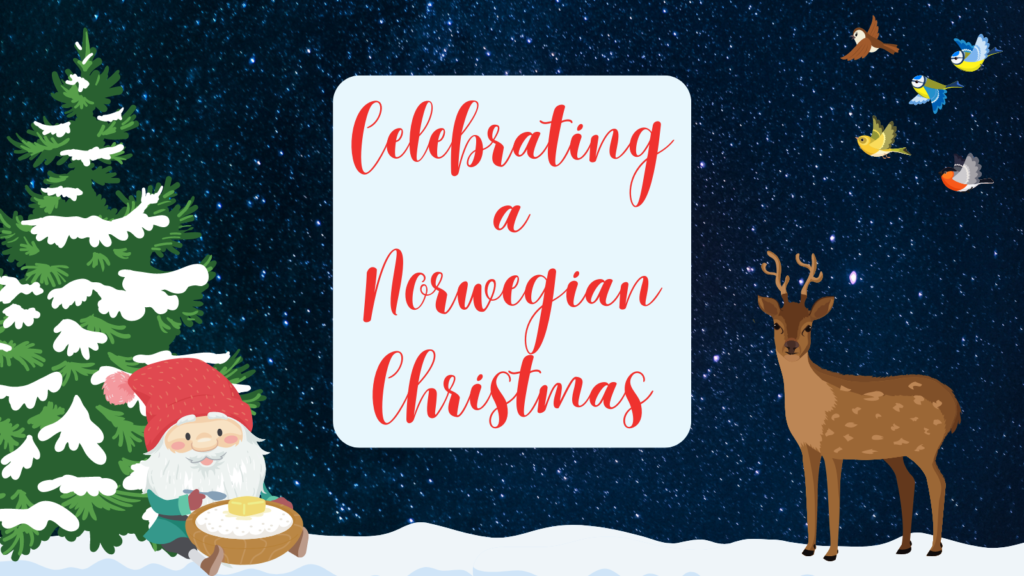
In Norway, the Christmas season is stretched over several weeks. It starts on the first Sunday of Advent, usually at the end of November. The Advent period lasts about four weeks until Christmas Eve. During Advent, a new candle is lit in a four-candle Advent wreath every Sunday. It’s a time of Christmas preparations – baking, decorating, shopping, and parties. On Christmas Eve, there are church services and families get together for the main Christmas meal. Presents are exchanged, and Julenissen may even visit and distribute presents. After Christmas Eve follows the period called “romjulen”, a quiet time until New Year’s Eve.
Would you like to experience a touch of Norwegian jul? Here are some ideas of what to watch, read, listen, do, and consume in these last few days of Advent and during romjulen that follows. God jul!
(Some of the links below are affiliate links. Any purchases you make through links on my blog may result in a small commission to me. I greatly appreciate it when you support my blog by clicking on these links to make purchases.)
Watch 👀


Home for Christmas (Netflix Original Series, 2 Seasons, 2020 & 2021)
A fun and atmospheric rom-com set in a Christmasy, winter wonderland in Norway! (It’s a bit raunchy at times, so beware if watching with young children.) Frustrated by all her friends being a part of couples and families and her family constantly commenting on her single status, Johanna rashly and falsely announces at a family dinner on the first Sunday of Advent that she has a boyfriend. Now she has to find one to introduce on Christmas Eve.
A Storm for Christmas (Netflix Limited Series Released Dec. 16, 2022)
I was hoping for a third season of Home for Christmas, but instead there’s a spin-off of sorts with this limited series. The main character and her father from Home for Christmas return but in totally different roles. The story takes place at the Oslo airport. Per Netflix’s description, “Destinies collide when extreme weather traps travelers and workers at an airport, forcing them to spend the final hours leading up to Christmas together.”
Three Wishes for Cinderella (Available through Amazon Prime Video)
Apparently, it’s a Christmas tradition for many Norwegians to watch the Norwegian dubbed version of the 1973 Czech movie Three Wishes for Cinderella. Last year, an updated Norwegian retelling was made by director Cecilie A. Mosli. The movie features spectacular shots of Norwegian winterscapes and architecture as well as glimpses of Norwegian culture. Consider putting it on your watch list!
Grevinnen og hovmesteren / Dinner for One (YouTube, Skit begins at 2:25)
This is a bizarre Norwegian tradition! Every year on Little Christmas Eve (Dec. 23) at 9:00 p.m., NRK, the Norwegian national TV station, shows this short black and white comedy skit (first released in 1963) about a butler and an elderly countess hosting a dinner for four imaginary guests. The link above includes an introduction in German. The skit begins at 2:25. “Same procedure as last year?” and “Same procedure as every year” are now common phrases in Norway.
Read 📚
There’s no better time to read books set during Christmas or winter than now. Below you’ll suggestions, and it wouldn’t be a Norwegian book list without some crime fiction as well.
For a list of Christmas books for families, visit my page Book List: Christmas in Scandinavia.
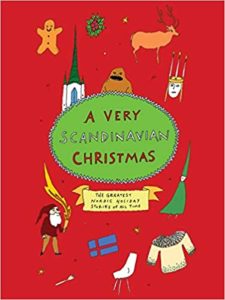
A Very Scandinavian Christmas: The Greatest Nordic Holiday Stories of All Time (2019)
From the publisher: This collection brings together the best Scandinavian holiday stories including classics by Hans Christian Andersen of Denmark; Nobel Prize winner Selma Lagerlöf, August Strindberg and Hjalmar Söderberg of Sweden; as well as the acclaimed contemporary Norwegian authors Karl Ove Knausgaard and National Book Award nominee Vigdis Hjorth. These Nordic tales―coming from the very region where so much of traditional Christmas imagery originates―convey a festive and contemplative spirit laden with lingonberries, elks, gnomes, Sami trolls, candles, gingerbread, and aquavit in abundance.
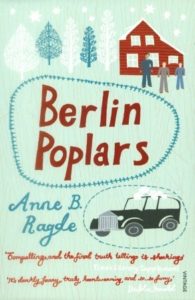
Berlin Poplars by Anne B. Ragde, translated from the Norwegian by James Anderson (First published in Norway in 2004)
Taken from the publisher: Aware of their 80-year-old mother’s failing health, three brothers reluctantly reunite over the winter holidays, where unexpected guests and the question of inheritance prompt the revealing of some bizarre, and devastating, truths.
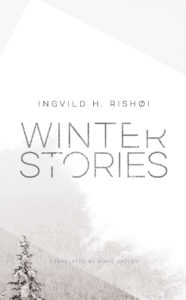
Winter Stories by Ingvild H. Rishøi, translated from the Norwegian by Diane Oatley (First published in Norway in 2014)
I don’t often read short story collections, but at a virtual event with Norwegian authors, this particular author was mentioned as a must-read and I was drawn to the serene winter cover. It’s a collection of three long short stories, all of which take place during winter time in Norway and are about vulnerable people (a young single mother, an ex-convict, and a teenager) trying to do their best for the young children in their lives, but with difficulty. The author does a compelling job of exploring their struggles, and in every story there’s an unexpected stranger whose compassion makes a significant difference. A five-star read for me.
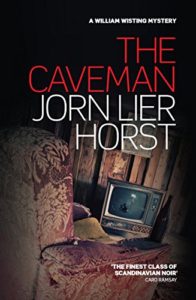


The Caveman (William Wisting Mystery) by Jørn Lier Horst, translated from the Norwegian by Anne Bruce (First published in Norway in 2013)
Jørn Lier Horst is my favorite Norwegian crime writer. The Caveman was the first of his that I read. Wisting is a likable and respectable police investigator who works in a smalltown, coastal community south of Oslo. His daughter Line, a journalist, is also a main character in this story. This installment takes place during the holiday season. Horst’s books usually tackle a greater social issue; this one reflects on forgotten and marginalized members of society. The Caveman won the the 2016 Petrona Award for the Best Scandinavian Crime Novel of the Year.
The Snowman (Harry Hole #7) by Jo Nesbø, translated from the Norwegian by Don Bartlett (First published in Norway in 2007)
I had read the first Harry Hole book a few years ago and wasn’t a fan of him (a too damaged alcoholic with poor judgement), but I wanted to give the series another try since it’s such a popular one both at home and abroad. I’m glad I did; this book was a fun ride! I really enjoyed that it took place in Oslo (November with the first snow). Also, Harry Hole’s character was much more likable; he doesn’t drink in this installment and his skills as a detective really shine. In this story, Harry is on the hunt for a serial killer who’s been targeting married women with children and leaves a snowman behind as a calling card. It was very engaging and suspenseful with a satisfying resolution.
The Redeemer (Harry Hole #6) by Jo Nesbø, translated from the Norwegian by Don Bartlett (First published in Norway in 2005)
This Harry Hole installment is even more of a Christmas crime read, though it does venture outside of Norway. From the publisher: Shots ring out at a Salvation Army Christmas concert in Oslo, leaving one of the singers dead in the street. The trail will lead Harry Hole, Oslo’s best investigator and worst civil servant, deep into the darkest corners of the city and, eventually, to Croatia. An assassin forged in the war-torn region has been brought to Oslo to settle an old debt. As the police circle in, the killer becomes increasingly desperate and the danger mounts for Harry and his colleagues.
Eat & Drink 😋
Norwegian Christmas Cookies – Syv slag kaker
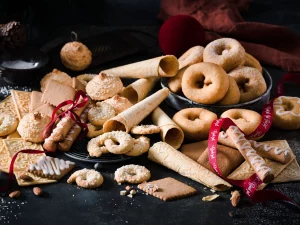 Christmas cookies are an important part of a Norwegian Christmas. The baking starts early and long standing tradition calls for syv slag, or seven varieties. The number seven was believed to bring luck and is an important religious number often symbolizing completion or perfection. The seven types are chosen based family preferences. Norwegian Christmas cookies all generally have the same basic ingredients (butter, flour, sugar, eggs) and are either baked, fried, or made with a special tool. My favorite type is krumkaker, a cone-shaped cookie made with a special flat iron. Berlinerkranser is another good one. This year I plan to try making serinakaker. Read more about Norway’s syv slag kaker at The Great Norwegian Christmas Cookie Extravaganza and 21 Norwegian Christmas Cookies for a Scandinavian Holiday.
Gløgg
Gløgg is a very popular warm beverage (may be alcoholic or non-alcoholic) served throughout the Christmas season. You’ll find it in homes, at parties, and out at Christmas markets. It’s usually made with red wine along with various mulling spices and served with raisins and almonds. You can make it from scratch or buy readymade gløgg (and potentially add your own wine or spirits) or you can buy mulling spices to add to your own seasonal beverage.
Risengrynsgrøt (Rice Porridge)
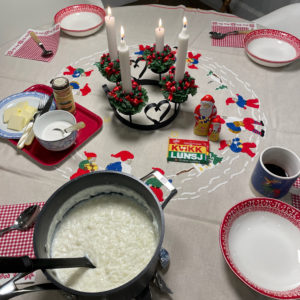 A popular food during Christmastime is risengrynsgrøt or rice porridge. It is served with butter, cinnamon, and sugar on top, and during Christmastime, it is traditional to hide a peeled almond in it. The person who finds it receives a marzipan pig as a prize (though my family is not a fan of marzipan so we have Norwegian chocolate as prizes instead). You can make it from scratch or buy a premade mix you heat up with milk.
For more inspiration related to eating and drinking, visit the websites of favorite Scandinavian food writers.
- Nevada Berg of North Wild Kitchen: Recipes, traditions and stories from Norway
- Kristi Bissel of True North Kitchen: Simple, seasonal Nordic-inspired recipes
- Daytona Danielsen: Helping you live your best Scandinavian life with food, family, and stories
Do 👐
Listen to Norwegian Christmas music.
 For me it’s not Christmas without my playlist of Christmas music which of course includes various Norwegian artists. Among my favorite songs are Kim Rysstad’s 2017 album Snøen laver ned (The snow is falling down) with the London Philharmonic Orchestra. I also enjoy songs from trumpeter Ole Edvard Antonsen’s 2010 Christmas album Desemberstemninger (December Moods). And finally, it’s not Christmas without some Sissel Kyrkjebø, Norway’s Queen of Christmas Music. Sissel has a new Christmas album out this season, Winter Morning. It was recorded in Utah with the Tabernacle Choir and Orchestra at Temple Square.
Make heart baskets.
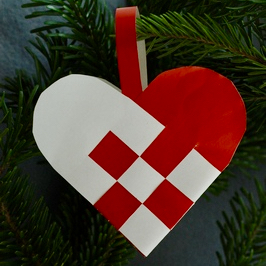 Paper heart baskets are popular not only in Norway but also in Denmark and Sweden. During Christmas time, they are used as decorations on trees or in garlands and may even hold candies and small treats. They can be simple and extremely complex. All you need is paper, scissors, and a little tape for the handle. Single color wrapping paper and construction paper work fine for this. See instructions here and watch this video to help with the weaving.
Go on a virtual visit to Oslo during Christmas time!
 In the video Christmas in Oslo: Festive Highlights from Oslo, Norway, it’s early December 2022 and winter has arrived in Oslo, though not the snow that is currently there now (at time of publication). The days may be short and dark, but the city is bright with festive decorations. Consider also taking a walk through the Oslo Christmas Market. For more glimpses of Christmas time in Oslo, watch Visit Norway’s photo series, The Christmas Town, Oslo, which covers everything from Christmas markets to ski jumping.
Watch St. Lucia celebrations with Rick Steves on a visit to Drøbak and Oslo.
In Rick Steves’ European Christmas, Rick visits Drøbak and Oslo to explore the Scandinavian Christmas tradition of Santa Lucia (December 13). Candle-bearing Santa Lucias bring light to the middle of winter and the promise of the return of summer. To capture the celebration, he traveled to Drøbak where kindergarteners bring light and saffron buns to a senior home and to Oslo where the Norwegian Girls’ Choir perform by candlelight in Gamle Aker Kirke, a tiny, heavy-stone, Viking Age church in Oslo (skip to 14:43 for segment on Norway). For some background information on the celebration, visit Life in Norway’s The Scandinavian Santa Lucia Celebrations Explained.
Wishing you and yours a wonderful holiday season! God jul og godt nytt år!

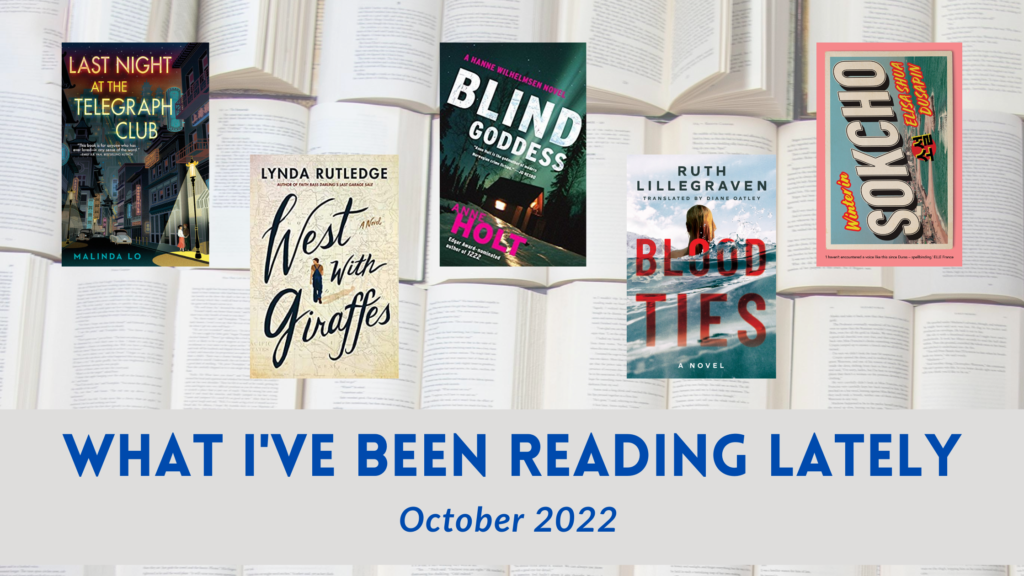
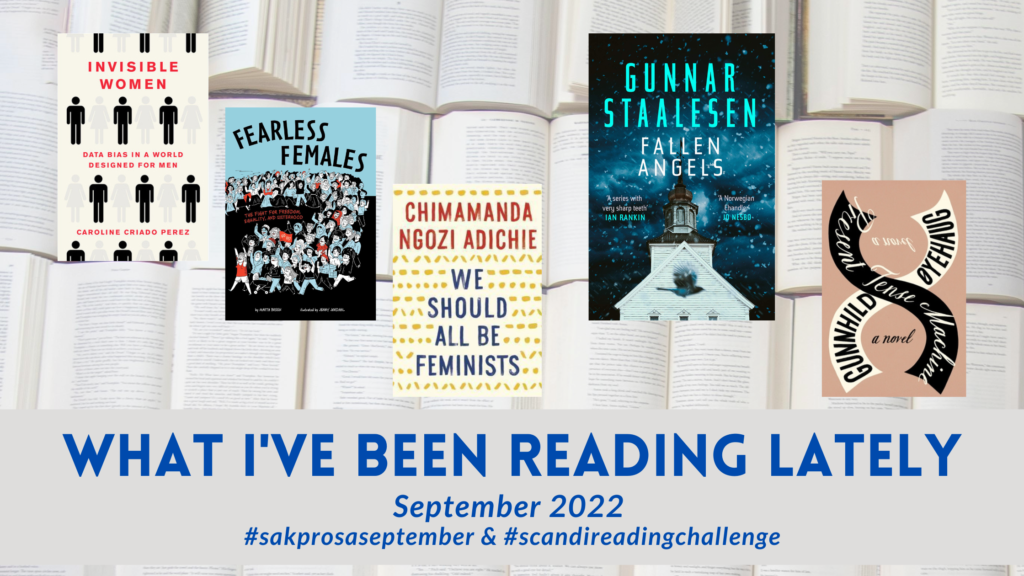
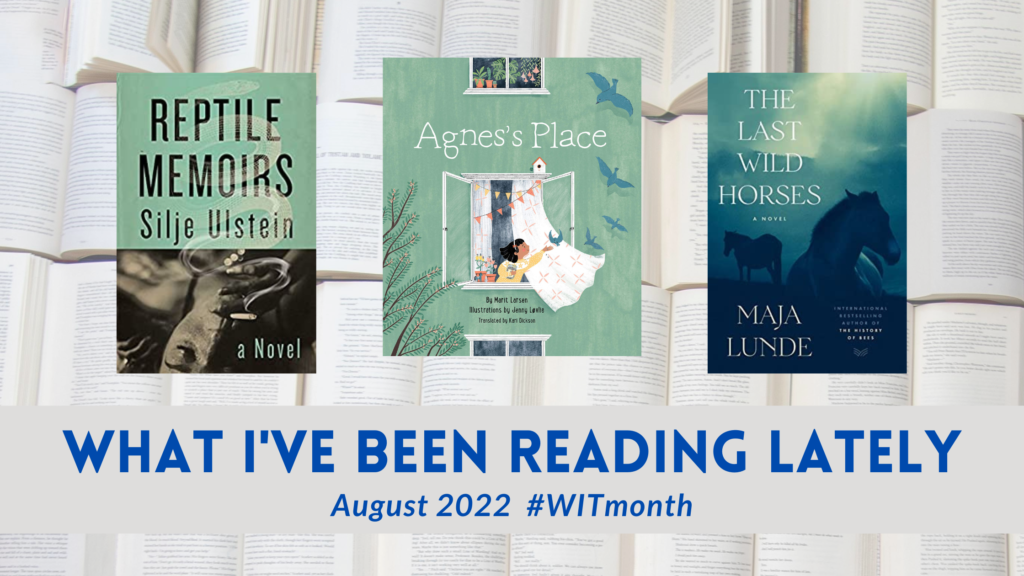
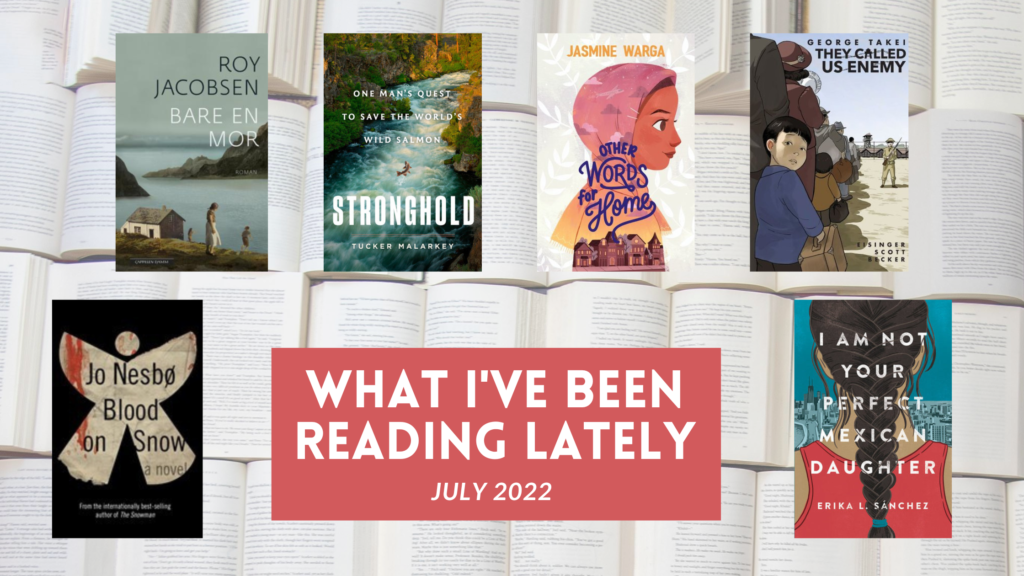
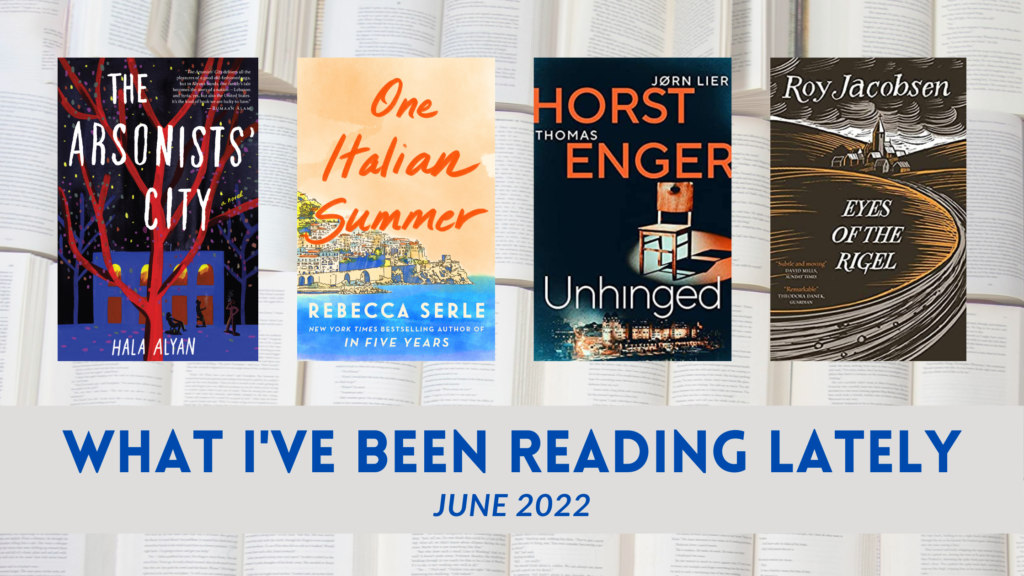 With summer now upon us, I am back on track with my reading. My goals for the summer are to catch up on reading challenges, play along with a summer reading bingo that is happening at work, and prepare and participate in
  Last year I read the author’s debut novel Salt Houses, which I really enjoyed, so when her second novel was
  I needed a light and easy audiobook that I could wrap up before our summer trip, and what better choice than one that would take me to the Amalfi Coast in Italy. Sadly, this book wasn’t for me. Yes, I escaped to Positano and vicariously enjoyed delicious food and fabulous views, but I was not a fan of the storyline. Thirty-something Katy’s mother, who was her best friend, just died of cancer and Katy decides to take the trip that they had planned to do together anyways. She’s distraught and lost, and on top of that, questioning her marriage. While in Positano she meets two Americans, Carol, who is just like her mother, and Adam, who is totally unlike her husband. There’s a lot of self-reflection and I’m not sure whether time travel or mental breakdown, but she finds herself actually with her mother as a 30-year-old. At that point, I almost stopped listening, but curiosity and the fact that it was a short listen got me to finish it.
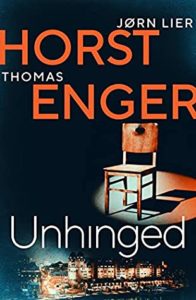 I needed a book that would jump start my summer reading so I finally read the third and latest English language installment in this Norwegian duo’s crime series. Like the others, it took place in Oslo and there were many places I recognized and knew, but the structure was very different, at least for the first half. It alternated between the interrogation of police office Alexander Blix about why he had shot someone, the interrogation of journalist Emma Ramm who saw what had happened, and the storyline of how the person was killed, so a lot of telling with jumps to actual action. The second half returned to a more traditional structure, but with a change in the focus of the investigation and a change in role for Blix. Unfortunately, the book was a bit of a disappointment for me. I wasn’t a fan of the structure of the first half and I didn’t like the new role for Blix.
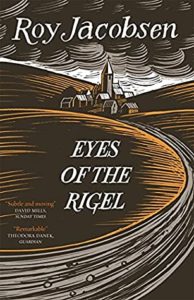 This is the third in a series of four about Ingrid, an independent woman born, raised, and living on a remote island in Northern Norway in the 1900s. This installment takes place just after World War II. Ingrid leaves the island with her baby girl and travels throughout Norway on foot/train/bus to track down the father, a Russian prisoner of war who spent a short while on the island towards the end of the war as Ingrid nursed him back to health after he had survived

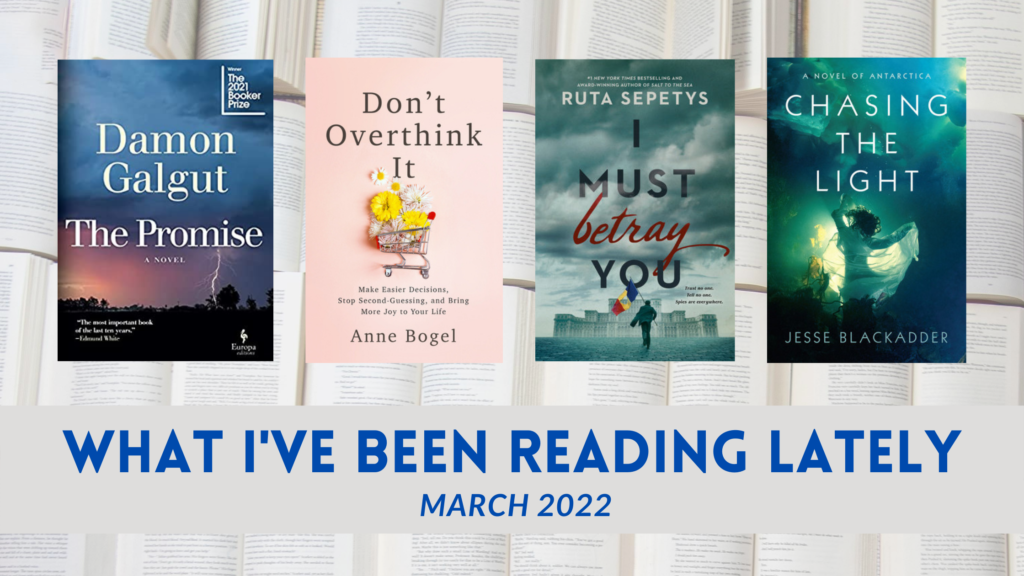
 This was a book club pick that I knew nothing about going in. Interestingly, what ended up intriguing me the most by the end was what bothered me the most at the beginning, the narrative voice and the narrator of the audiobook. At the beginning, I found the tone very annoying — strong, pronounced, and all-encompassing. However, once I realized that was the intended effect (and that the prose was written in free form without quotation marks with the dialogue and narrative merging, something I don’t like), I continued the audiobook with a new perspective and an open mind and found it very enjoyable. The story is about a white South African family and a promise that takes decades to fulfill. The dying mother wanted their long-time servant to receive the house on the property in which she lived. It begins during Apartheid and jumps by decades to the present. The narrator of the story has an attitude and opinions which they don’t hold back, making this a very unique reading/listening experience.
 I’ve had this book by a favorite blogger/podcast host on my bookshelf for a couple of years but just never got around to reading it. When I discovered the audiobook was available at hoopla, I downloaded it immediately and decided to make it my next read instead of listening to a podcast. In a way, it would be like a podcast since the author, also host of a favorite podcast, reads it herself. It was a short and sweet listen which provided much useful food for thought regarding decision making. Some of the material was a good reminder of familiar concepts; other sections were new ways of thinking about issues.
 What an eye-opening and heart-breaking look into life in communist Romania under the dictator Nicolae Ceaușescu in the 1980s. The story takes place over a span of only a few months in 1989 leading up to the revolution in December. All 17-year-old Cristian really wants to do is write and spend time with the girl he has a crush on, but the regime has other plans for him. He is blackmailed by the secret police into becoming an informer. It was shocking to see how deep and wide the “citizen spy network” worked and its effect on families. I’ve been a great fan of Ruta Sepetys’ previous historical fiction novels, and this new release didn’t disappoint.
 I so wanted to love this book. It was a book about three women competing to become the first women to set foot on Antarctica. Equally intriguing was that it was during a period of Norwegian history unfamiliar to me, Norway’s whaling industry in the 1930s. The historical aspect met my expectations, though did not exceed because it was very fictionalized. The characters were based on real people, but the voyage depicted in the book was actually an amalgamation of various voyages to Antarctica by the women involved. The afterword by the author was important in sorting out what was true and what was not. What turned me off the most, however, was the female camaraderie, or actually lack thereof. On this very long, tough journey in a very male-dominated environment, I was hoping/expecting them to be more well-intentioned towards one another and supportive of each other, but that was not the case, and that was frustrating to me.
 This was not the easiest book to get into, but I’m glad I stuck with it because suddenly (at about 25%) it all began to fall into place and ended up being a very rewarding reading experience. I started by listening to it, but I had a hard time following the story with its three narratives. I switched to the ebook and that made a huge difference. I did not have any background knowledge for this book, not about Australia in general and definitely not Australian indigenous history in particular, which probably hindered my comprehension at the beginning also. I thought the structure of the book with the dictionary by the grandfather, the letter written by the missionary, and the narrative of the granddaughter returning to her homeland for her grandfather’s funeral worked very well together. I really enjoyed seeing how it all came together by the end and it opened my eyes to a whole new chapter in world history, in this case effects of the British colonization of Australia.